The honeymoon phase of centralized cloud AI is over. While the last few years were defined by the rapid adoption of ChatGPT and Claude, 2026 is the year of Data Sovereignty. For any business handling proprietary code, medical records, or sensitive financial data, the risk of "leaking" information to a third-party provider is now a boardroom-level liability.
Deploying Large Language Models (LLMs) locally is a strategic move for enterprise security and cost efficiency. By moving inference in-house, you shift AI costs from an unpredictable monthly subscription (OpEx) to a stable, depreciable asset (CapEx).
2026 Hardware Build Guides: From Prosumer to Data Center
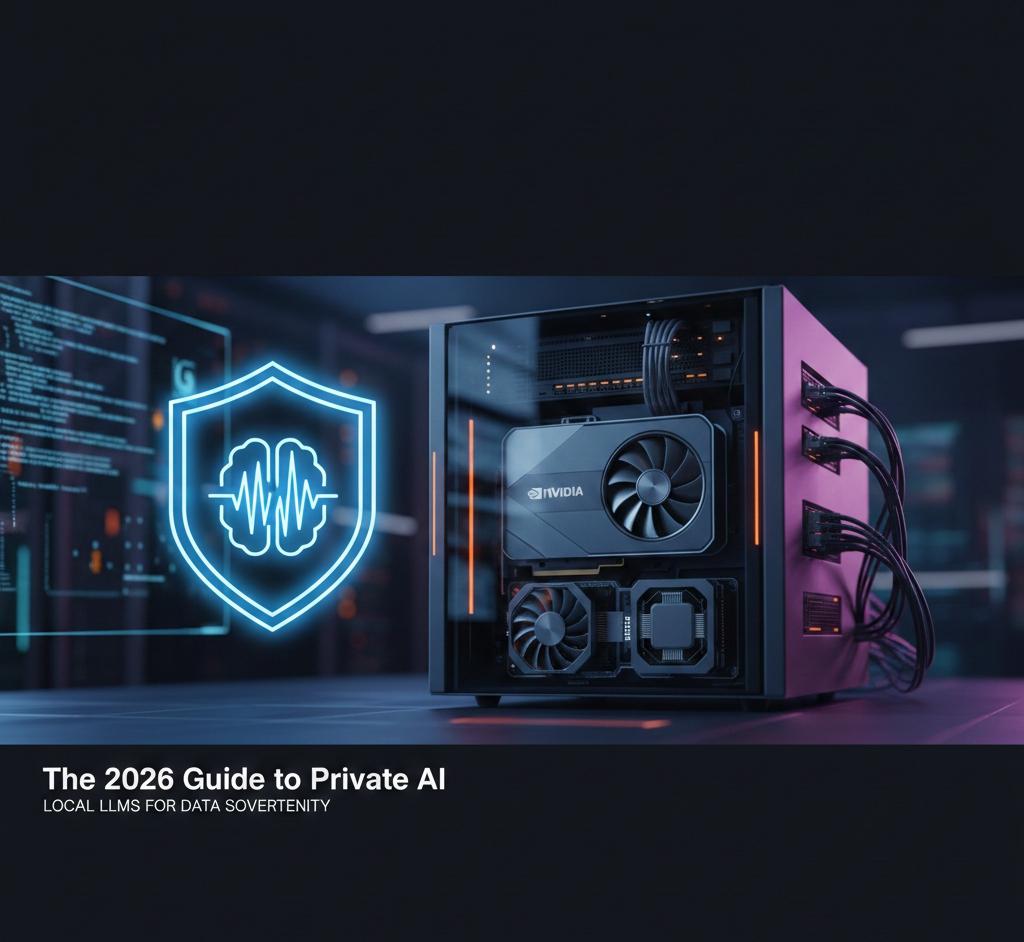
To run modern models like Llama 3.3 (70B) or DeepSeek-V3, your hardware must prioritize VRAM (Video RAM) and Memory Bandwidth. Below are three specific configurations designed for different business scales.
1. The "Power User" Workstation
Ideal for: Individual developers, researchers, and small legal or medical offices.
- GPU: 1x NVIDIA RTX 5090 (32GB GDDR7)
- CPU: AMD Ryzen 9 9950X (16-core)
- RAM: 64GB DDR5-6400 ECC
- Storage: 2TB NVMe Gen5 SSD
- Capability: Runs 8B to 14B parameter models at instant speeds; runs quantized 70B models at usable speeds (5-10 tokens per second).
2. The "Departmental" Private Cloud
Ideal for: Mid-sized teams (20-50 people) requiring shared access to a centralized internal model.
- GPU: 2x NVIDIA RTX 6000 Blackwell (48GB each, total 96GB VRAM)
- CPU: AMD Threadripper Pro 7975WX (32-core)
- RAM: 256GB DDR5 ECC (allows for massive context windows)
- Power: 1600W Titanium-rated PSU
- Capability: Supports concurrent users on a 70B parameter model with zero latency; handles extremely long documents.
3. The "Enterprise" Infrastructure
Ideal for: Large corporations requiring unquantized, high-precision models and heavy fine-tuning.
- Compute: NVIDIA H200 (141GB HBM3e) or H100 (80GB) PCIe clusters
- Alternative: Apple Mac Studio (M4 Ultra) with 512GB Unified Memory
- Interconnect: NVLink or 400GbE InfiniBand
- Capability: Runs the largest "Frontier" models (400B+ parameters) entirely in-memory with maximum reasoning accuracy.
Budget-Friendly Alternative
Test Private AI for Free (Cloud Option)
If a $5,000 workstation isn't in your budget today, you can rent enterprise-grade NVIDIA GPUs by the hour. This allows you to test your private LLM stack without the upfront investment.
Claim Your $300 Vultr Credit 🎁 2026 Promo: Includes $300 in free testing credits for new accounts.
Why Local AI is the Ultimate Privacy Power Move
Compliance without the Compromise
Regulatory bodies such as GDPR, HIPAA, and the latest 2026 AI Act updates are increasingly strict about where data is processed. A local LLM allows you to:
- Process PII (Personally Identifiable Information): Analyze customer data without ever sending a single packet to an external API.
- Maintain Audit Trails: Every interaction is logged internally, providing full transparency for compliance audits.
Eliminating the "Token Tax"
Cloud AI providers charge per token, making budgeting for a scaling company nearly impossible. Once you own the hardware, your cost per token effectively drops to the price of electricity. For organizations spending more than $500 per month on APIs, a local setup typically reaches break-even in 8 to 14 months.
Security Hardening: Protecting Your Local AI
Local does not automatically mean secure. To ensure your private LLM is truly protected, follow these steps:
- VLAN Isolation: Keep your AI server on a segmented network with zero outbound access to the public internet.
- Standardized API Access: Use an API gateway like Ollama or vLLM to manage keys, rate limits, and user permissions.
- Input Filtering: Implement a guardrail layer. Even a local model can be tricked into revealing sensitive info if a user tries a prompt-injection attack.
Conclusion: The ROI of Privacy
By 2026, the competitive advantage in tech goes to those who own their intelligence. Deploying LLMs locally is not just about avoiding a data breach: it is about building a faster, cheaper, and more reliable brain for your business.