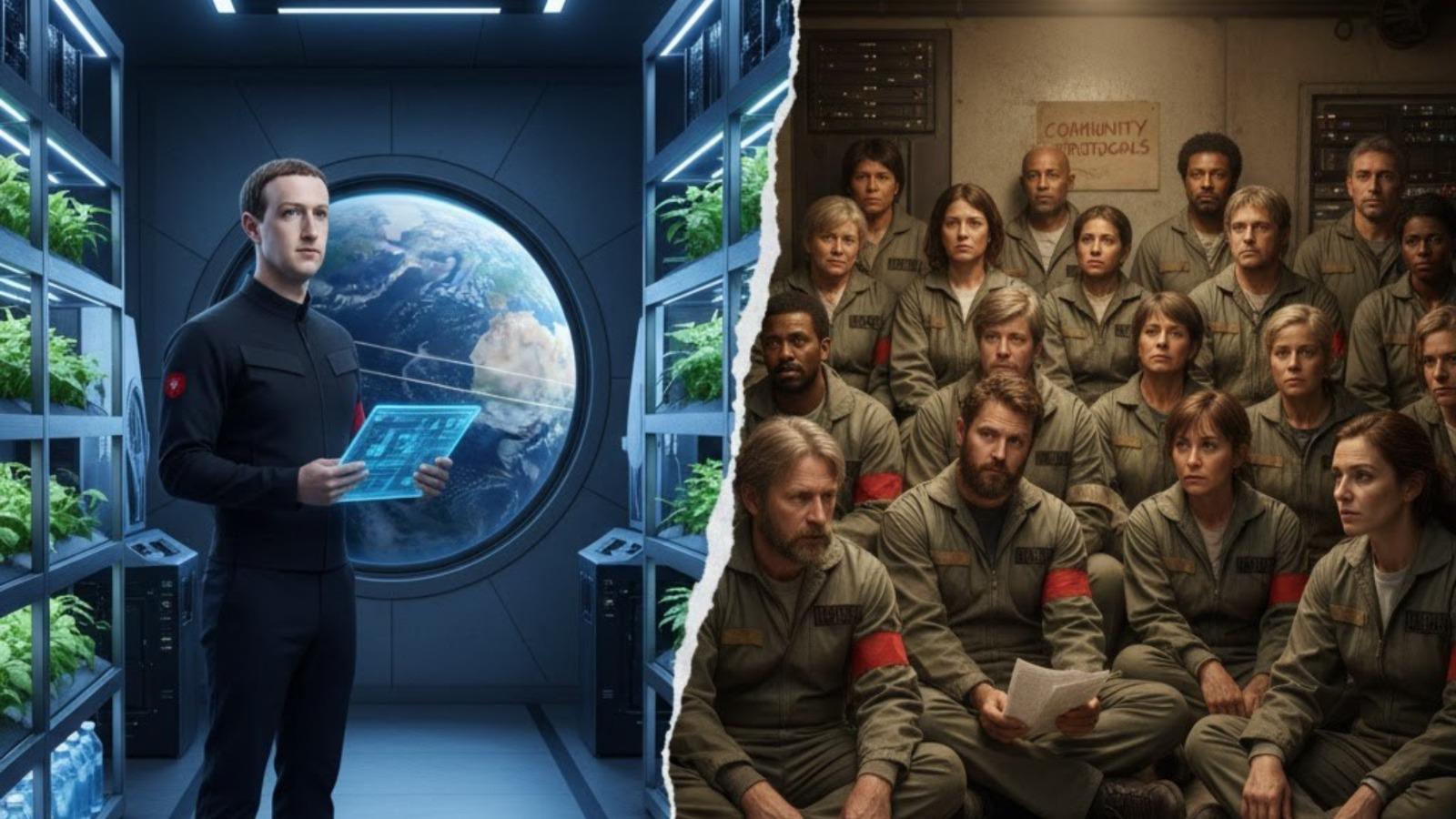
As global instability rises, the world’s elite are building massive private compounds rather than joining communal shelters. This post explores the "Bunker Paradox"—why billionaires like Mark Zuckerberg and Jeff Bezos prioritize radical isolation over shared survival. Discover how a total lack of social trust, the "guard problem," and the psychology of greed make a shared foxhole a non-starter
In the silent, high-altitude plateaus of New Zealand and the volcanic coastlines of Hawaii, a transformation is occurring in the world of luxury real estate. The "Billionaire Bunker" has transitioned from a fringe conspiracy theory into a defining architectural movement of the 2020s. Mark Zuckerberg’s $270 million Kauai estate, Jeff Bezos’s Miami "Billionaire Bunker" island, and Peter Thiel’s Alpine retreats are not just homes; they are high-tech lifeboats designed to survive the collapse of the very civilization that built them.
However, a glaring trend has emerged that defies traditional survival logic: these sanctuaries are strictly private. While the upper-middle class and "prepper" communities invest in shared survival pods like Vivos—relying on the strength of numbers—the world’s 0.001% are choosing total, radical isolation. This choice is not accidental. It is the result of a calculated, cold-blooded assessment of human nature, security, and the ultimate limits of trust.
Why will the world’s most powerful people never share a foxhole? The answer lies at the intersection of psychology, security, and the Insulation Mindset—a belief that safety is something that can only be owned, never shared.
For a billionaire, a shared bunker is not a refuge; it is a tactical liability. In a doomsday scenario, the primary threat is not the radiation, the virus, or the civil unrest outside; it is the power dynamic within the walls. Media theorist Douglas Rushkoff famously recount an anecdote where tech moguls asked him how to maintain control over their armed security guards once money becomes worthless.
The Loyalty Paradox: In a shared facility, multiple security teams increase the chance of a "palace coup." If three billionaires share a bunker, whose guards are truly in charge? In a power vacuum, the man with the gun becomes the sovereign.
Sequestration of Loyalty: Private bunkers solve this by creating "captive loyalty." Billionaires plan to house the families of their security detail within the bunker. By protecting the guard’s children and spouses, they create a biological and emotional contract that replaces the financial one.
The Target Factor: A communal bunker housing ten of the world's most hated or envied individuals is a massive "high-value target." A single, discreet private estate is far easier to camouflage and defend.
2. The Psychology of the Sovereign Individual
The tech elite often subscribe to the philosophy of the Sovereign Individual. This worldview posits that in the digital age, high-net-worth individuals will eventually operate as independent states, separate from the nation-state. To them, a shared bunker feels like a return to the "social contract"—a concept they have spent their careers trying to transcend through automation, offshore accounts, and decentralized technology.
Greed and Resource Scarcity
Billionaire survivalism is a zero-sum game. Whether it is oxygen filtration cycles, specialized medical supplies, or the yield of a subterranean hydroponic garden, sharing resources contradicts the foundational principle of extreme wealth: exclusive accumulation. Every additional person in a bunker is a statistical drain on the system's longevity. In the billionaire’s survival calculus, empathy is seen as a resource leak that could shorten their own survival by months or years.
3. Inconvenience in Human Desire: The Luxury Gap
At the billionaire level, "survival" is not about canned beans and thermal blankets; it’s about the continuity of lifestyle. Modern private bunkers are engineered masterpieces designed to simulate a world that no longer exists. They often feature:
Digital Nature: Floor-to-ceiling LED "windows" that simulate 24-hour cycles of the owner's favorite landscapes, synced to real-time weather data.
Legacy Vaults: Private servers containing the sum of their data, DNA repositories, and climate-controlled galleries for physical masterpieces.
Sharing these spaces introduces social friction. These are individuals used to being the most powerful person in any room. Putting ten "Alpha" personalities in a high-stress, enclosed environment for months is a recipe for psychological warfare. When desire outweighs the collective good, the shared bunker becomes a powder keg of ego. They would rather rule a kingdom of one than compromise in a democracy of ten.
4. The Technical Stack of Solitude
The move toward private bunkers is also driven by proprietary technology. Many of these compounds use custom-coded AI to manage life-support, security, and food production. Sharing a bunker would mean sharing intellectual property and security architecture with peers who—in the post-event world—might still be competitors. In the minds of the tech-elite, their neighbor is just as much a competitor during an apocalypse as they were during a market cycle. Privacy is not just about comfort; it is about keeping their "operating system" for survival hidden from potential rivals.
5. Sanitizing History: The Fear of Accountability
In a shared bunker, a billionaire is forced to live with witnesses. In a private bunker, they are the sole author of the narrative. If the "Event" is caused by climate change, economic collapse, or technological fallout, the people most responsible for those systems may not want to spend their remaining years looking into the eyes of peers who know exactly how the world was broken. Isolation allows for a sanitization of history where the owner is the hero of their own story, undisturbed by the guilt or judgment of others.
Comparison: Private vs. Shared Survival
Strategic Feature
Private Billionaire Bunker
Shared Survival Community
Governance
Absolute Autocracy (The Owner)
Democratic or Committee-Based
Security Model
Family-Sequestration & AI
Communal Militia & Peer Review
Resource Management
Unlimited Luxury (Hoarded)
Rationed/Essential (Shared)
Social Risk
Internal Mutiny
Social Instability & Infighting
Psychological State
Radical Isolation / "God Complex"
Collective Burden / Support
Conclusion: The Ultimate Hedge
The refusal to share bunkers is the most profound admission of a lack of social trust in human history. While anthropologists like Margaret Mead suggested that civilization began with a healed femur—a sign that someone helped another survive—the billionaire class is betting that civilization ends with the rejection of the collective. They are betting on technological self-sufficiency over human cooperation.
For the person who has everything, the one thing they cannot buy is the guarantee that their neighbor won't turn on them when the lights go out. Their solution? Ensure there is no neighbor at all. The billionaire bunker is the ultimate monument to the belief that one can buy their way out of the human condition, even if it means surviving in a world of one.
This week in AI: China's Kimi K2 model outperforms leading systems at a fraction of the cost. MagicPath launches a Chrome extension to clone any website design. Lightricks releases LTX-2, the first open-source AI generating synchronized 4K video and audio. Plus, enterprise AI adoption accelerates with major banks reporting significant productivity gains.
An expert breakdown of CES 2026, exploring how robotics, intelligent devices, and next‑gen computing are shaping technology and professional workflows in 2026.
A thoughtful exploration of how modern AI tools are reshaping professional productivity in 2026, with practical insights, real world scenarios, and an honest look at limits and tradeoffs.